
AI, Work, and Creativity
AI Slop Is Not the Whole Story: The Skill of Asking Better Questions

The backlash to AI slop names a real problem: effortless first drafts everywhere. But the deeper skill is not producing more. It is asking better questions, testing the frame, and using AI as a tool for judgment rather than a substitute for it.
Spend a few minutes online and you will eventually encounter the phrase: AI slop.
It usually points to the same recognizable experience. A feed fills with images that are technically polished but strangely interchangeable. Songs appear with the contours of songs but none of the felt decisions. Articles sound fluent until you notice that no one seems to have had a reason to say any of it. The material is not always ugly. It is often worse than ugly: it is frictionless, abundant, and forgettable.
That reaction is understandable. There is a real difference between a person making something because they have a point of view and a system producing endless variations because it can. Calling every criticism of AI anti-technology would miss the point.
But there is a second mistake hiding inside the phrase. It can make AI itself look like the author of the emptiness, as if the machine's first response were the full measure of what a person can make with it.
It is not. A generic request produces a generic answer for the same reason a vague brief produces a generic campaign, a vague question produces a generic meeting, and a vague search produces a generic list. The tool is responding to the frame it has been given. The work begins when someone notices that the frame is too shallow.
In an age of easy generation, one of the most valuable skills may be the least flashy one: curiosity disciplined enough to ask a better question.
The First Output Is Usually a Beginning, Not a Verdict
Most of us were trained by search engines. Type a question, receive an answer, move on. That is a useful habit when the question is small: What time does a store close? Where is a setting? What does a word mean? It becomes a poor habit when the task is creative, strategic, personal, or ambiguous.
Ask an AI to write a campaign, make an image, solve a workflow, design a product page, plan a trip, or explain a hard problem, and it can return something competent in seconds. The speed is dazzling. It is also psychologically dangerous. A fast answer can feel like a finished answer because it arrives wearing the surface signals of completion.
That is where the fluency illusion enters. We often mistake ease of processing for truth, quality, or understanding. A smooth paragraph feels smarter than a rough one. A sleek image feels more intentional than it may be. A confident plan feels more workable than a plan that admits what it does not know.
AI makes this trap unusually available because fluency is one of its great strengths. It can make the average answer sound composed. It can turn a thin premise into a polished paragraph. It can make a visual look finished before anyone has decided whether the visual says anything.
The corrective is not to distrust every fluent output. It is to change the job we give the first output. Treat it as a sketch, a proposal, a map of the obvious terrain, or a useful wrong turn. Then ask: What is missing? What assumption did this inherit from my wording? What would make this more specific to the actual people, place, stakes, or feeling involved?
The first answer is often the most conventional answer because conventional answers are the safest response to an underspecified request. That does not make them useless. It makes them a starting point.
A Prompt Is Not Just a Command. It Is a Frame
The Medium essay that inspired this piece makes a helpful distinction: there is a difference between typing a prompt and asking a question. A prompt can be a request for output. A question can be an investigation into the problem itself. The difference matters because an AI system will generally work inside the problem you hand it unless you deliberately invite it to examine the problem with you.
Imagine asking, 'Make me a website for my business.' You may get a perfectly recognizable website: a large hero message, features, testimonials, a call to action. That is not evidence that the model lacks imagination. It is evidence that the request supplied very little reason to depart from the most common pattern.
The better move is not merely to pile adjectives onto the same command. It is to question the premise. What does this business need a visitor to understand before anything else? What part of the usual website would make this feel generic? What action should a customer take after thirty seconds? What can the site show that a sales claim cannot prove? What should the design refuse to imitate?
Those questions supply judgment, context, taste, and stakes. They are not decorative details. They are the human contribution.
This is why people working well with AI often describe a conversation rather than a magic prompt. They give the tool examples, constraints, priorities, source material, and feedback. They ask it to compare options. They ask it to expose tradeoffs. They ask it what it needs to know before offering a confident recommendation. Then they decide which suggestions deserve another round.
Good prompting is not about finding a secret spell. It is about becoming clearer about what you are trying to do.
The Thinking Traps That Make AI Feel Worse Than It Has To
Several familiar cognitive patterns can sabotage that process. They do not only make an AI result worse. They make us less likely to notice why it is worse.
Automation bias is the tendency to give a system's suggestion too much weight simply because a system produced it. When a model returns a confident answer, a user can stop checking the premises, sources, math, or missing context. The answer seems less like one possible output and more like a recommendation from an authority. The antidote is simple but demanding: ask the tool to show uncertainty, alternatives, and failure cases, then verify the parts that matter.
Anchoring bias gives the first number, phrase, image, or structure we encounter disproportionate influence. In AI work, the first generated concept can quietly become the standard against which every later idea is judged. That is why a creator can spend an hour making tiny edits to a mediocre first image instead of asking for three genuinely different directions. Before refining, deliberately request contrast: give me the opposite approach; give me the least obvious interpretation; show me what this would look like if the central assumption were false.
Confirmation bias appears when we use AI to reinforce the conclusion we already want. A leading question can turn a model into a very persuasive assistant for our existing view. 'Explain why my competitor's strategy will fail' is not the same as 'Make the strongest case for this strategy, then identify the conditions under which it breaks.' The second question is less emotionally satisfying. It is far more useful.
Functional fixedness narrows a tool to the first use we recognize. If AI is only a content generator, then we ask it to make more content. But it can also be a critic, a researcher, a simulator, a role-play partner, a translator between domains, a way to surface assumptions, or a patient interviewer that helps a person articulate what they already know but have not yet organized. The most interesting uses often appear when we stop asking, 'What can it make for me?' and start asking, 'What part of this process needs a different kind of thinking?'
These traps are not a case against AI. They are a case for staying mentally present while using it.
The Difference Between Output and Collaboration
There is a version of AI use that deserves the word slop. It is the version where the user has no intention beyond volume: type a broad request, accept the first response, publish it, repeat. Nothing is examined. Nothing is made more particular. No one asks whether the result is true, useful, beautiful, appropriate, or even necessary.
But there is another version, and it looks almost opposite. A musician can use a model to explore an arrangement they would never have tried, then make the actual decisions that give the piece character. A designer can generate visual directions, identify the one with a real emotional charge, then develop it through many revisions. A small business owner can ask a tool to explain the systems behind a problem, test several paths, and build something that once required an entire team to prototype. A writer can ask the model to interrogate a half-formed idea until the personal observation inside it becomes visible.
In each case, the machine increases the number of available moves. The person still chooses the game.
That choice is not a minor cleanup step. It is where responsibility lives. A model has no lived reason to prefer one direction over another unless the user supplies one. It does not know which detail carries emotional truth for your audience, which tradeoff you can accept, which voice sounds like you, or what the work is meant to change. It can help expose options. It cannot inherit a reason for caring.
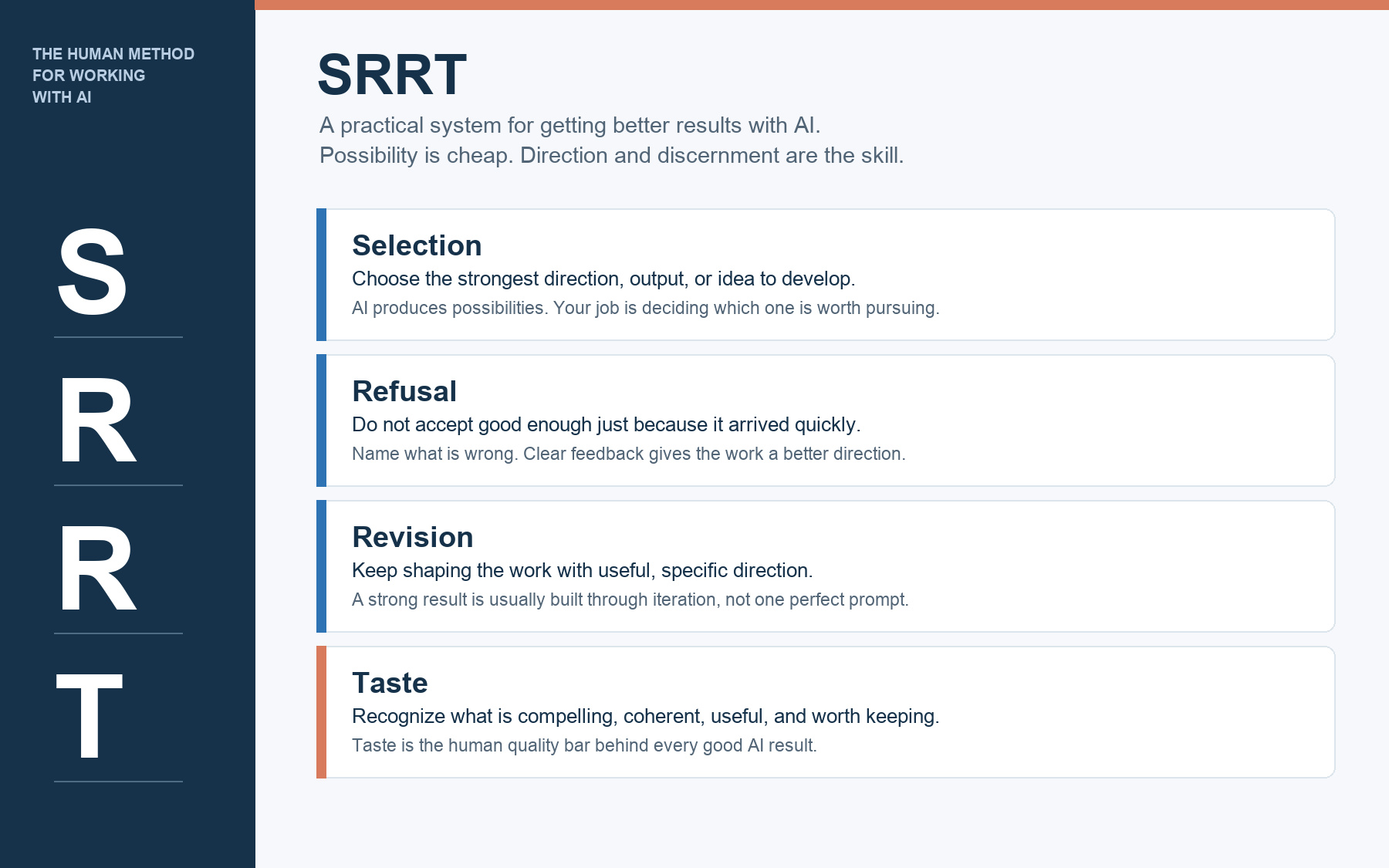
This is also why the best results can feel personal rather than synthetic. The creator has used the system's range without surrendering their own point of view. The work still bears fingerprints: not necessarily the fingerprints of manual labor at every pixel or sentence, but the fingerprints of selection, refusal, revision, and taste.
Ask the Tool to Ask You Questions
One practical shift changes the whole interaction: stop making the model guess your missing context. Ask it to interview you first.
Instead of: 'Write an article about AI and creativity.' Try: 'Before drafting, ask me the questions that would help uncover a specific argument, personal stake, tension, and audience. Do not write until you have enough detail to tell me what the article is really about.'
Instead of: 'Design a brand for my business.' Try: 'Interview me about the customers, category cliches, emotional tone, practical constraints, and brands I admire or reject. Then summarize the creative brief you believe I am actually giving you, including assumptions I should challenge.'
Instead of: 'Help me decide what to do.' Try: 'Ask me what success, downside, reversibility, and missing evidence look like here. Then present two opposing interpretations of my situation before recommending next steps.'
These are not merely stronger prompts. They are small systems for resisting our own first instincts. They make the process slower at the beginning so it can become more original, more accurate, and more useful later.
Curiosity is not an aesthetic preference. It is quality control.
The Future Skill Is Not Knowing the Magic Words
There will always be people selling prompt formulas, shortcut packs, and the idea that a single perfectly worded instruction separates amateurs from experts. Some practical prompt structure is helpful. Clear goals, relevant context, examples, constraints, and a definition of success all improve the odds of a useful response. The major AI platforms themselves emphasize explicit instructions and evaluation rather than blind faith in a single output.
But the deeper skill sits underneath the syntax. It is the willingness to notice when a response is too easy, a frame is too narrow, a question is leading, or an attractive output is covering an empty idea. It is the habit of asking one more question after the answer feels complete.
That habit works whether the tool is a language model, an image generator, a spreadsheet, a search engine, a colleague, or a notebook. AI has simply made the contrast clearer. When generating is cheap, discernment becomes more visible. When answers are abundant, a good question gains value.
The phrase AI slop is useful when it reminds us that not everything generated deserves attention. But the better response is not to retreat into contempt for the tool or nostalgia for a pre-AI world. It is to become more demanding of the interaction.
Ask what the output is assuming. Ask what it leaves out. Ask for the counterargument. Ask for three directions that do not resemble each other. Ask it to show its uncertainty. Ask it to interview you. Ask whether the problem you handed it is even the problem you should be solving.
Then bring something the machine cannot supply on its own: a reason to care about the answer.
Sources and Context
Check question: Am I treating the first plausible output as the answer, or as a clue to the better question I should ask next?