Attention, Algorithms, and Deep Media
TikTok Brain: When Everything Has to Capture You
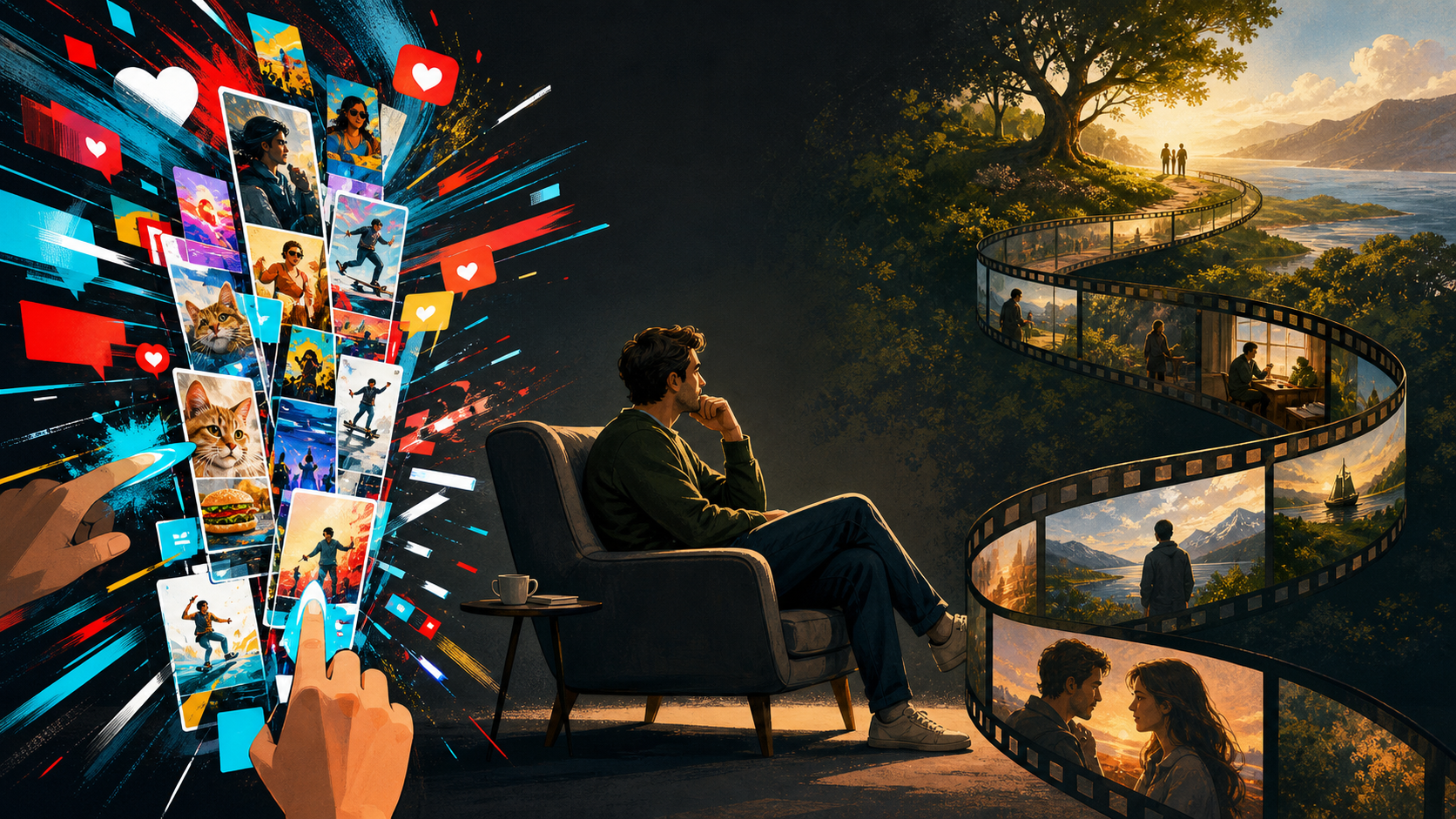
Short-form feeds do more than occupy our time. They can train us to expect immediate rewards, distrust slow stories, and blame worthwhile work for requiring attention.
Recently, I sent one of these essays to someone I know. He did not finish reading it or listening to the audio version. His explanation was simple: it did not capture him.
Another time, I sent a friend a movie I had worked hard on. He told me he scrubbed through it. He moved the playhead across the timeline, sampled scattered moments, and reached the end without ever sitting through the film.
Both responses felt personal. Making something requires sustained attention. Hearing that someone would not give it sustained attention can sound less like feedback and more like a description of how little the work was worth to them.
But after the irritation came a more interesting question.
When did attention become something content owes us every second?
We increasingly speak as if a reader or viewer is passive and the work must continuously seize, stimulate, and retain them. If attention slips, the article failed. The movie dragged. The podcast lost us. The creator did not hook us quickly enough.
Sometimes that judgment is correct. Some writing is shapeless. Some films mistake slowness for depth. Nobody is morally obligated to finish everything placed in front of them.
But 'it did not capture me' may describe the work. It may also describe the condition of the viewer.
TikTok Brain Is Not a Diagnosis
I jokingly call this TikTok Brain. The phrase is useful because people immediately recognize the behavior: reaching for a phone during a quiet scene, abandoning an article after two paragraphs, watching a movie while simultaneously scrolling, or speeding through anything that does not deliver an obvious payoff right away.
TikTok Brain is not a clinical diagnosis, and ordinary distractibility should not be casually labeled a mental illness. Attention problems can have many causes, including stress, sleep loss, anxiety, depression, ADHD, demanding work, and simple exhaustion. Diagnosing friends from their viewing habits would be both unfair and scientifically empty.
The phrase is better understood as a cultural shorthand for an acquired expectation: content should change quickly, reward us immediately, and require almost nothing before proving its value.
TikTok did not invent distraction. Nor is every short video empty. Short-form media can teach, entertain, document, and connect with remarkable efficiency. The deeper issue is the consumption system built around it: endless supply, personalized recommendations, immediate novelty, effortless exits, and almost no natural stopping cues.
The feed does not merely show us content. It lets us rehearse a particular relationship with attention hundreds of times in a sitting.
Interested? Stay for a few seconds. Uncertain? Swipe. Slightly bored? Swipe. Already understand the premise? Swipe. Feel an uncomfortable emotion? Swipe. The next possibility is always one thumb movement away.
Practice that rhythm long enough and a slower form can begin to feel incorrectly designed simply because it asks for a different kind of participation.
The Feed Changes the Contract
A traditional story makes a contract with its audience. Give me your attention now, and I will make these details matter later.
A character is introduced before we understand their importance. A quiet scene establishes a relationship that will transform a later decision. An essay places two ideas in tension and withholds the resolution. A joke builds through timing. A piece of music repeats a phrase until one small change becomes emotionally enormous.
These forms rely on memory. They ask us to carry information forward. Their reward is cumulative rather than constant.
The feed offers a different contract: I will prove my value immediately, and you may leave the instant I stop.
That contract is extraordinarily competitive. Every clip is surrounded by millions of possible replacements. Creators learn to front-load movement, conflict, captions, surprise, emotional intensity, and promises of a payoff. Viewers learn that almost any moment of friction can be solved by replacement.
The result is not necessarily an inability to pay attention. People can remain on a short-video platform for an hour. The problem is that the hour may consist of hundreds of tiny attentional commitments, each abandoned and renewed before anything must deepen.
We have not stopped paying attention. We have become highly practiced at paying attention in fragments.
What the Evidence Can Actually Say
The popular claim that modern humans now have an eight-second attention span is not a sound scientific fact. Attention is not one fixed countdown clock, and performance depends on the person, task, environment, motivation, and kind of attention being measured.
The research is more interesting than the slogan.
A recent experiment on short-form video found that rapid context switching during an interruption could impair prospective memory: the ability to remember and carry out an intention later. An EEG study has also reported associations between heavier short-video use and differences in attentional functioning.
A 2025 randomized trial took a broader approach. Participants blocked mobile internet on their smartphones for two weeks while retaining calls, texts, and internet access on other devices. The intervention improved objectively measured sustained attention, mental health, or subjective well-being for most participants. People also spent more time socializing face to face, exercising, and being in nature.
That does not prove that one app permanently rewires every user. The broader literature on media multitasking is mixed. Meta-analyses find some associations with distractibility, working memory, and inhibitory control, but many effects are small, vary by measurement method, and do not establish which direction causation runs.
Perhaps distractible people seek more fragmented media. Perhaps fragmented media reinforces distractible habits. Perhaps both are true, with sleep, stress, personality, age, and context changing the effect.
We do not need to pretend the science is simpler than it is. The strongest claim is also the most believable: environments shape habits, and the form of attention we repeatedly practice becomes the form that feels most natural.
A recent Atlantic essay, 'The End of Reading Is Here,' placed this concern inside a larger decline in reading stamina. Its central warning is not that literacy suddenly disappears. It is that complex skills weaken when we stop practicing them. Deep reading becomes harder, so we avoid it; avoidance then makes deep reading harder still.
Attention can enter the same loop.
Thinking Trap One: Present Bias
Present bias makes an immediate reward feel more valuable than a larger reward that arrives later.
The next short video offers novelty now. A complex movie may need twenty minutes to establish its world. An essay may not reveal its full argument in the opening paragraph. A novel may ask the reader to tolerate uncertainty for chapters.
Against an infinite feed, delayed meaning is placed in an unfair contest with instant stimulation.
The viewer knows, abstractly, that finishing a thoughtful work may be more satisfying. But the future payoff is quiet and uncertain. The next swipe is vivid, effortless, and available immediately.
This changes how boredom is interpreted. Boredom once marked a temporary state that might pass as we entered the rhythm of a task. Under present bias, boredom becomes evidence that a better reward should be selected now.
The question is not whether immediate entertainment is bad. It is whether we still notice the exchange being made: a small reward now for the abandonment of a deeper one later.
Thinking Trap Two: Salience Bias
Salience bias causes what is loud, vivid, emotional, or unusual to dominate judgment.
Short-form feeds are machines for producing salience. The opening second must move. The face must react. The caption must announce stakes. The edit must arrive before stillness becomes risk. Even useful information is often packaged as revelation, outrage, danger, or secret knowledge.
After enough exposure, quieter signals can begin to register as absence. Subtle acting looks uneventful. A patient explanation feels weak. Atmosphere feels like delay. An unresolved idea feels incomplete rather than inviting.
But noticeable is not the same as meaningful.
A film's most important moment may be a hesitation. An essay's most useful sentence may clarify rather than shock. A friend's most revealing emotion may appear in what they struggle to say. These signals ask for attention before they advertise their importance.
Salience bias reverses that order. It tells us that whatever deserves attention will first make itself impossible to ignore.
Thinking Trap Three: Fluency Illusion
The fluency illusion occurs when ease of processing gets mistaken for real understanding.
Scrubbing through a movie is a nearly perfect example. The viewer encounters the characters, locations, visual style, major set pieces, and perhaps even the ending. Everything looks familiar afterward. That familiarity can create the feeling of having consumed the film.
But recognition is not experience.
The viewer did not hold earlier details in memory, feel time pass with the characters, absorb the pacing, sit inside uncertainty, or allow one scene to alter the meaning of another. Scrubbing can reveal what happens while removing how and why it matters.
The same thing happens when an article is skimmed for bold phrases or reduced to a summary. Information is extracted, but the chain of reasoning is not reconstructed. The person reaches the conclusion without traveling the intellectual distance that gives the conclusion weight.
This is why short summaries can inform us while still leaving us unable to explain, evaluate, or remember what we supposedly learned.
Fluency feels efficient. Sometimes it is. But when the form itself carries meaning, friction is not wasted time. It is part of the experience.
Dopamine Is Not the Whole Explanation
It is tempting to say every swipe delivers a dopamine hit and leave the explanation there. That phrase is catchy, but it can turn neuroscience into another piece of short-form content: simple, stimulating, and more confident than the evidence allows.
Dopamine is involved in motivation, learning, reward prediction, and the pursuit of potentially valuable outcomes. It is not a tiny packet of pleasure released in identical amounts by every entertaining clip.
The design problem can be explained without pretending to measure a neurotransmitter from the couch. Personalized recommendations improve the chance that the next item will feel relevant. Variable quality creates anticipation. Infinite scroll removes stopping cues. Low-friction switching makes departure easier than persistence. Social metrics add approval and comparison.
The system does not need to make every clip satisfying. It only needs to make the next clip feel worth checking.
The Fair Objection: Maybe the Work Was Boring
Creators can become defensive about attention. Because a work required effort, we may feel that other people owe it time. That is effort justification, and it deserves scrutiny too.
A movie does not become good because it was difficult to make. An essay does not become clear because it took days to write. Audiences are allowed to leave. Friends are allowed to dislike our work. Pacing, structure, clarity, and emotional access matter.
The point is not that every abandoned work is secretly profound.
The point is that 'it did not capture me' is incomplete feedback. It treats attention as a measurement device without checking whether the device has been calibrated by hours of rapid novelty.
A fair evaluation asks two questions at once: What did the work do to earn attention, and what habits did the viewer bring to the encounter?
Creators are responsible for communication. Viewers are responsible for participation. Meaning often requires both.
Attention Is Something We Do
The language of capture makes attention sound involuntary. Something captures us or it does not. We are seized by a headline, pulled into a clip, hooked by an opening, or lost by a slow scene.
But attention is also an action. We direct it, protect it, withdraw it, divide it, and strengthen it through use.
This matters because helplessness is profitable. If attention can only be captured, then the most aggressive stimulus wins. If attention can be chosen, then we can give it to something before that thing has fully rewarded us.
That does not mean forcing ourselves through everything. It means recovering the ability to distinguish 'this has no value for me' from 'this has not rewarded me yet.'
A Small Deep-Attention Reset
Choose one work you genuinely want to experience: a film, essay, album, chapter, conversation, or long interview.
Give it twenty uninterrupted minutes. Put the phone outside arm's reach. Do not scrub, accelerate, open another tab, or check how much time remains. Decide on the stopping point before you begin rather than renegotiating at every flicker of boredom.
When the urge to switch appears, notice what you are asking for. Is it new information? Emotional intensity? Certainty? Relief from effort? The urge is data about the attentional habit, not an instruction that must be followed.
At the end, summarize what changed across those twenty minutes. Not merely what happened, but what became more meaningful because you stayed.
This is not punishment and it is not nostalgia for a supposedly purer pre-phone world. It is practice in retaining the freedom to choose slower rewards.
The Viewer Has Changed Too
Platforms should be examined. Creators should improve their work. Schools and families should protect time for reading, play, boredom, conversation, and sustained projects. But none of those responsibilities removes the viewer from the equation.
When someone says a work did not capture them, perhaps it failed.
Or perhaps it asked for ten minutes of patience from a mind trained to renegotiate its attention every ten seconds.
The uncomfortable truth is that both can be true. Our media can become more manipulative while our standards for effort become less demanding. Content can get better at capturing us while we get worse at choosing what deserves to hold us.
Scrubbing is not watching. Skimming is not understanding. Exposure is not attention. And attention is not proof that something was worthwhile any more than boredom is proof that it was not.
Before blaming the next article, film, book, or person for failing to hold you, ask a more revealing question.
Is this failing to hold my attention, or have I lost some of my ability to give it?
Sources and Context
- The Atlantic: The End of Reading Is Here
- PNAS Nexus: Blocking mobile internet improves sustained attention, mental health, and well-being
- Memory: Context-switching in short-form videos and prospective memory
- Frontiers in Human Neuroscience: Mobile short-video use and attention functions
- CHI 2024: User engagement with TikTok's short-format recommendations
- Cyberpsychology: A meta-analysis of media multitasking and cognitive control
Check question: Is this failing to hold my attention, or have I lost some of my ability to give it?