
Architecture, Memory, and Meaning
When a Room Has No Reason to Exist
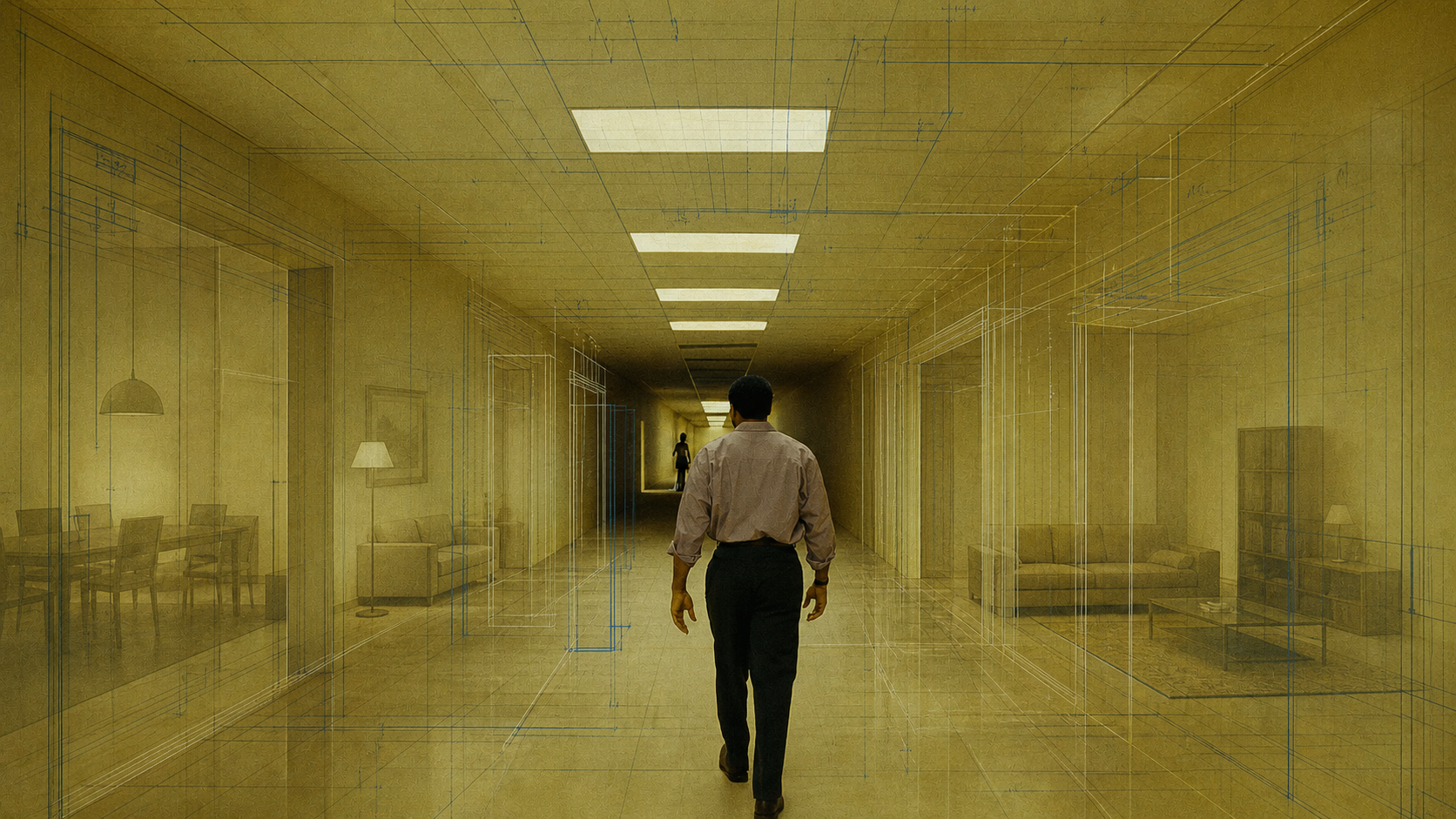
The Backrooms turns ordinary architecture into psychological horror by preserving the appearance of function after function has disappeared.
A hallway is a promise.
It tells you that one place connects to another. A door promises a room. A waiting room promises that someone will eventually call your name.
Architecture rarely explains these promises. Our bodies already know what stairs, corridors, chairs, and exits are asking us to do.
Then there are the rooms in The Backrooms.
Kane Parsons' film begins with a strange doorway beneath a furniture showroom. On the other side is a seemingly endless environment of corridors, offices, thresholds, and rooms that resemble useful places but cannot explain their use.
The walls stand. The lights hum. The carpet continues.
But the promise has been broken.
That may be the film's most unsettling idea. Its architecture preserves the appearance of function after function has disappeared.
Architecture Tells the Body What to Do
Psychologists and designers use the word affordance for the possibilities for action that an environment offers. A chair affords sitting. A handle affords pulling. A doorway affords passage.
We do not encounter architecture as neutral geometry. We experience it through potential movement: where we can walk, what we can reach, and which boundary we can cross. These possibilities influence how we process a space before consciously analyzing it.
The Backrooms scramble that relationship.
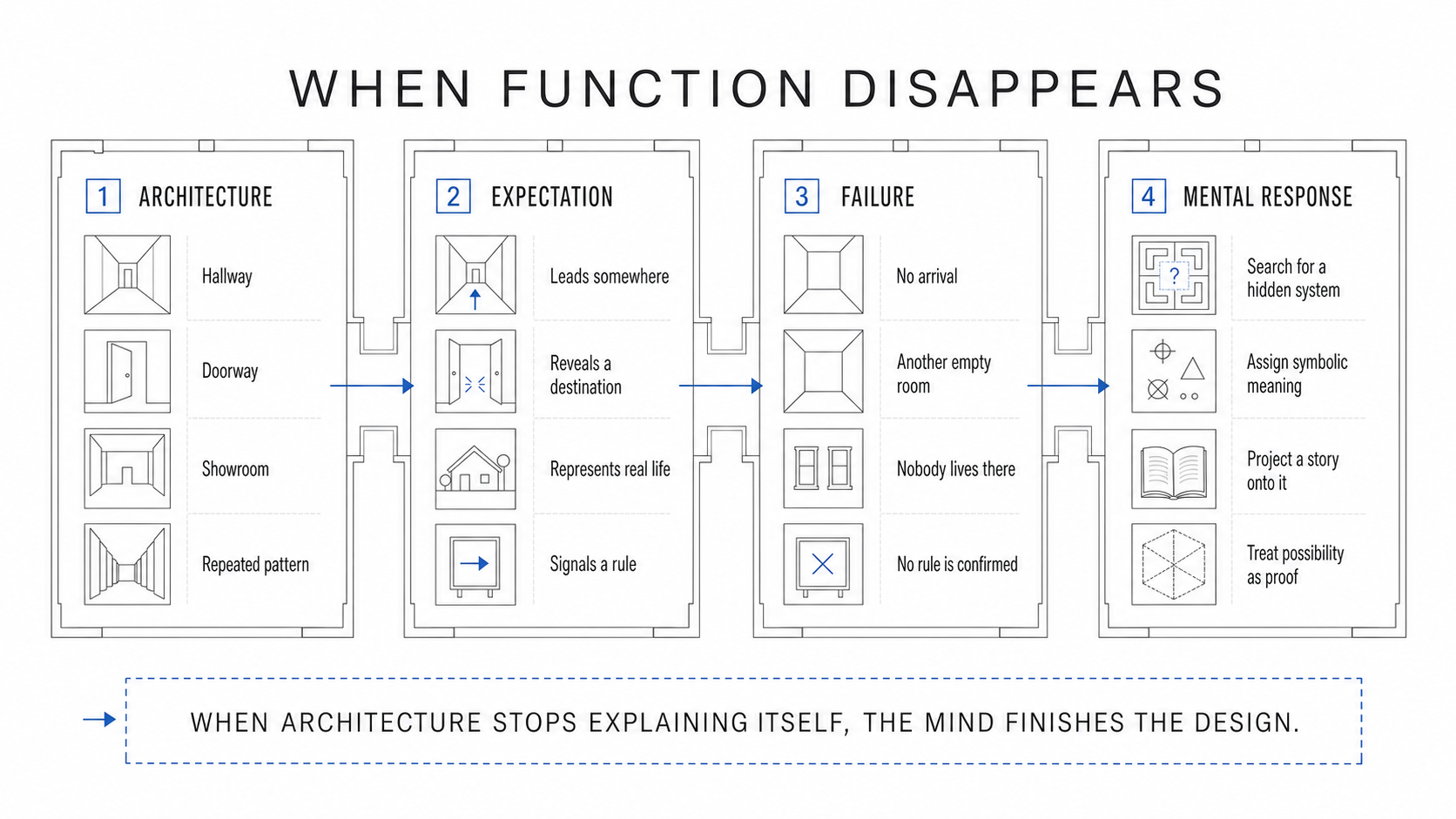
A hallway still affords walking, but walking may not produce arrival. A doorway invites passage without guaranteeing a meaningful destination.
That is more disturbing than a landscape never designed for us. An office corridor appears to belong to a human system. When the system is missing, the mind goes looking for it.
We assume there must be a plan because the space looks planned.
The Showroom Before the Maze
The furniture showroom is an especially fitting entrance.
A showroom is already a simulation of inhabited life. It contains bedrooms where no one sleeps, dining tables where no one eats, and living rooms assembled to suggest conversations that never occurred.
Its purpose is to help us imagine a future. The objects are real, but the life surrounding them is projected.
The Backrooms preserve that sense of simulation while removing the commercial explanation. They resemble places made for people, but the people, activity, and purpose are absent.
A showroom manufactures the feeling of a life that has not happened. The Backrooms preserve the feeling after removing the life.
Emptiness alone is not what makes a liminal space unsettling. The unease begins when a room looks intentional but its intention cannot be recovered.
When Function Disappears, Meaning Rushes In
Human beings readily explain things through purpose. A building was designed for something. A repeated architectural feature must serve a larger system.
This tendency becomes a thinking trap when the evidence cannot support the purpose we assign.
The Backrooms invite this constantly. If a room contains an unusual object, we assume it is a clue. If a corridor repeats, we suspect a pattern. If one environment resembles another, we search for the rule connecting them.
Sometimes the connection is intentional. Filmmakers use repetition, visual echoes, and symbolism deliberately. The trap begins when a possible interpretation hardens into certainty.
This detail could mean something.
Then: It must mean this.
This is where apophenia, the perception of meaningful connections among unrelated events, meets our need for closure. The unexplained space produces discomfort. A theory reduces it. Once the theory works emotionally, we can mistake relief for proof.
The less practical information the architecture provides, the more psychological meaning the viewer supplies.
A Memory Palace Built Wrong
The film's architecture also behaves like memory.
We often imagine memory as stored footage: a stable record retrieved from an internal archive. But remembering is reconstructive. We rebuild an experience using fragments, expectations, later information, and the story we currently tell about ourselves.
That makes memory less like a recording and more like a room renovated each time we enter it.
The Backrooms turn this process into physical space. Familiar environments return with altered proportions. Places repeat without remaining identical. Emotional truth can survive while literal accuracy dissolves.
A traditional memory palace uses stable architecture to organize information. You place an idea in a familiar room, then return to retrieve it.
The Backrooms resemble a memory palace operating in reverse. The rooms do not stabilize memory. Memory destabilizes the rooms.
Places help organize experience. A childhood kitchen or school corridor can activate memories before we search for them. Yet remembered places remain vulnerable to revision. Dimensions shift, different years merge, and a room can stay emotionally precise while becoming architecturally impossible.
The Backrooms are not simply a maze inside memory. They are what memory looks like when it becomes the maze.
The Trap Inside the Interpretation
Two viewers can experience the same unexplained room and complete it differently.
One sees grief made architectural. Another sees hidden machinery. Someone else sees a story withholding information it should have supplied.
The film remains the same. The architecture has given each viewer enough structure to enter, but not enough function to settle the meaning.
Ambiguity is not automatically depth. A story can establish rules and violate them carelessly. Calling every inconsistency symbolic creates a system in which criticism becomes impossible.
The useful question is not whether every room has a definitive explanation. It is whether we can distinguish among three things.
First: What the film actually shows.
Second: What the design reasonably suggests.
Third: What we supply because uncertainty feels unfinished.
That distinction matters far beyond movies.
We encounter similar gaps in memories, public events, and other people's behavior. We see a structure but not its function, then infer purpose and connect fragments.
Then we forget which parts of the structure were already there.
The Room That Cannot Explain Itself
You do not need to see The Backrooms to understand its central fear.
Imagine entering a room built for an apparent reason. The lights work. Another doorway waits at the opposite end.
Everything suggests that the room belongs to an intelligible system.
Nothing can tell you what that system is.
The horror does not begin when something enters the room. It begins when the room stops being able to explain itself.
Our instinct is to repair that failure with meaning. We search for the architect, the rule, the memory, or the hidden intention that will make the space functional again.
An explanation always appears to be one hallway away.
And so we keep walking.
Sources and Context
- A24: Backrooms
- Frontiers in Psychology: Sensorimotor brain dynamics reflect architectural affordances
- APA Dictionary of Psychology: Reconstructive memory
- Personality and Individual Differences: Need for cognitive closure under uncertainty
- Consciousness and Cognition: Apophenia and perceived patterns
- Inverse: Backrooms director Kane Parsons on the film and its architecture
Check question: What does the evidence tell me this is for, and what purpose am I supplying because purposelessness feels intolerable?