
Technology, Media, and Judgment
When a Robot Crash Becomes the Whole Story
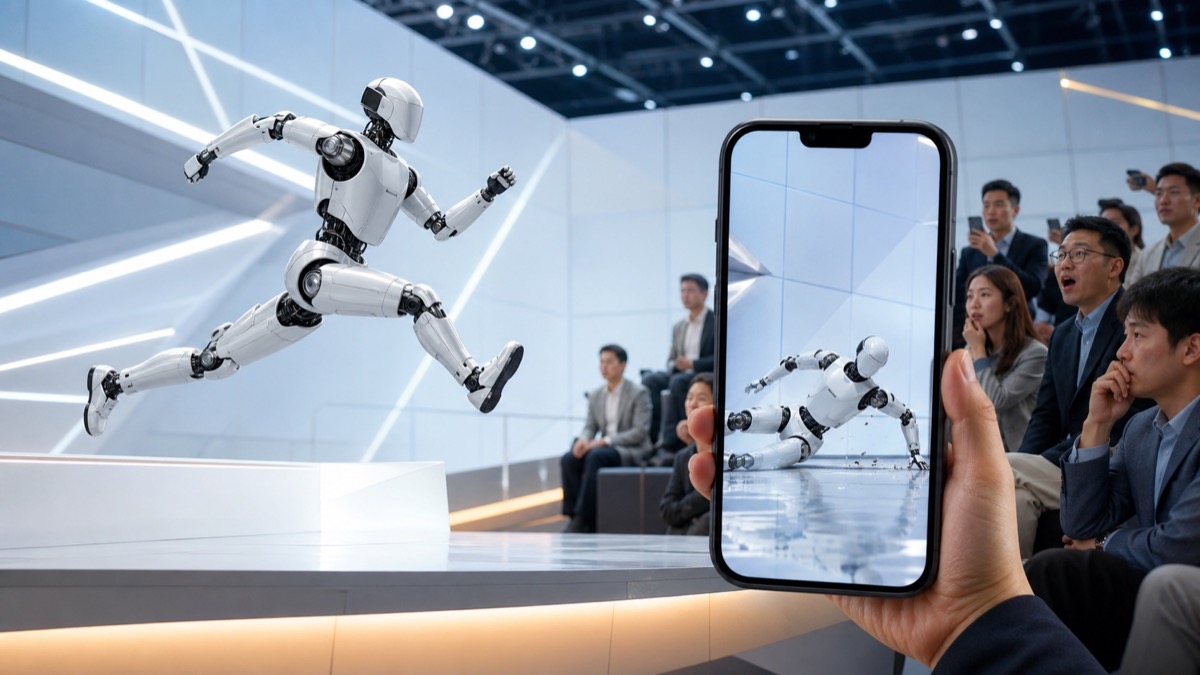
A Unitree humanoid's remarkable reported speed and a separate viral crash clip at Beijing's robot conference reveal how easily one vivid moment can become our entire verdict on a technology.
A humanoid robot runs at a startling speed. Then it falls.
That is more or less the internet's preferred format for technological judgment: a breakthrough compressed into a short clip, followed by a failure clip that seems to settle the argument. In the span of a scroll, one side gets its proof that the future has arrived. The other gets its proof that it is all smoke, mirrors, and a very expensive person in a costume.
Unitree, the Chinese humanoid-robot maker, has supplied both kinds of material. The company recently previewed a machine it calls Superman and reported a top speed of 12.66 meters per second, along with a two-meter standing jump. Around the same surge of attention, video of a humanoid losing balance at a Beijing robot event gave the internet a cleaner, funnier, more shareable image: the robot on the floor.
Neither reaction is absurd. A bipedal machine moving that quickly is remarkable. A machine that can fall in a public demonstration raises real questions about robustness, safety, and the distance between a spectacular demo and ordinary deployment. The mistake begins when either frame becomes the whole model.
This is not a story about whether people should be impressed or skeptical. They should be both. It is about why the mind finds it so hard to hold progress and limitation in view at the same time, especially once an image gives us the pleasure of a final verdict.
The Clip That Became the Verdict
At Beijing's World Robot Conference, robots were not hidden in a lab. They boxed, danced, played table tennis, and performed the work of being watched. That is part of the point of a public technology show. A machine has to demonstrate what it can do. It also has to become a story that people can carry away.
The fall travels better than the conditions around it. A viral post rarely includes the surface under the robot's feet, the control mode, the number of successful trials, the safety system, the task it was attempting, or the recovery protocol. It offers the clean image: this thing cannot even stay upright.
That image feels like evidence because it is evidence. It shows a real limit in one real moment. But it is only one kind of evidence. It cannot, on its own, tell us how often a robot fails, how it performs under a defined workload, whether it can recover, what risk it poses around people, or how its performance compares with the previous generation.
The availability heuristic makes that distinction easy to lose. Information that is vivid, recent, and easy to picture receives more weight in our judgments than information that is slower or more technical to absorb. A fall has gravity. A reliability curve does not. The problem is not that we remember the fall. The problem is that remembering it can make us feel that we have measured the category.
What the Robot Actually Demonstrated
There is a symmetrical error on the other side. A reported top speed of 12.66 meters per second sounds like a declaration that a robot has outrun the human frontier. It is an extraordinary figure, and the underlying control challenge is real. Making a biped coordinate balance, joints, perception, and impact while moving quickly is not a parlor trick.
But a peak number is not the same thing as a complete capability claim. A fast run does not establish endurance, safe stopping, manipulation, reliability under load, economical maintenance, or usefulness in a crowded workplace. It does not tell us how many attempts produced the result or what happens when the environment stops cooperating.
A good demonstration deserves to be seen as a demonstration. It becomes misleading only when it is asked to carry more than that. The company-reported speed is a signal about what may be technically possible. It is not, by itself, a certified athletic comparison, a business case, or a forecast of how soon humanoids will be common in homes and factories.
That is where scope neglect enters. We can let one striking attribute stand in for the entire technology. The fact that a machine can run becomes a story about what machines will soon do everywhere. The fact that a machine falls becomes a story about what machines will never do. Both conclusions are more satisfying than the middle ground because the middle ground requires separate questions.
Why Failure Is More Memorable Than Progress
People are not uniquely unfair to robots. We do this with self-driving cars, new software, experimental medicine, athletes, public officials, and our own work. Ten competent performances fade into the background. One visible failure can reorganize the whole story.
That is negativity bias. Potential danger deserves attention because danger can be costly. A humanoid falling near a person is not merely embarrassing. It has safety implications. An article about robots that ignored that fact would be doing hype, not thinking.
But the same bias can make failure feel more diagnostic than it is. A fall becomes the image that confirms an existing belief: AI is fake, robotics is overhyped, nobody has solved the hard part, investors are being fooled. The more coherent that story feels, the less we notice that a clip cannot settle all those claims.
There is a useful phrase in the research and safety world: fail passive. With many conventional machines, cutting power can move the system toward a safer state. A walking biped is harder. Its stable state is actively controlled. Remove the control, and falling itself can be the hazard. That technical reality makes the viral crash more than a joke. It also makes a joke an inadequate safety analysis.
The Market Is Watching the Same Movie
The emotional split is not only happening in comment sections. It is happening in markets. Unitree's Shanghai debut drew intense investor interest, with shares initially rising as much as 629% before closing far higher than their offering price, according to the Associated Press. That movement reflects excitement about embodied AI, Chinese manufacturing capacity, and the possibility that humanoid robotics is becoming investable before it is ordinary.
A rising share price is its own kind of clip. It turns a complicated thesis into a bright, visible line. People can begin to treat the market's enthusiasm as proof that the technology is solved, just as critics treat the fall as proof that it is not. In both cases, attention turns into certainty faster than understanding.
This is social proof at a very high resolution. When many people appear to be impressed, buying, posting, or laughing, the group supplies a feeling of consensus. Consensus can be informative. It can also tell us mainly that a story is contagious.
The Better Question Is Not 'Real or Fake?'
The internet loves binary questions because they are easy to distribute. Is this a breakthrough or a bust? Is it a robot future or a robot flop? Is the company a sign of industrial strength or a symbol of hype? Those questions generate sides. They do not generate much clarity.
A better set of questions is more specific. What was the robot designed to demonstrate? Under what conditions did it succeed? What failed, and how often? What safety system existed? Which tasks are closest to useful deployment, and which remain stagecraft? How does this result compare with a relevant baseline rather than a science-fiction expectation?
Those questions are less cinematic. That is precisely their advantage. They make it harder for a glorious run or an awkward crash to hijack the entire evaluation.
The Unitree story is a small lesson in a large habit. When a new technology becomes visible, we often rush to decide whether it deserves awe or ridicule. Both feelings can arrive before we have decided what evidence would actually change our minds.
A robot can be impressive and not ready. It can fail and still represent real progress. The work of judgment is refusing to let the most shareable frame do all the thinking for us.
The Wright brothers did not prove flight by producing one perfect, cinematic takeoff. Their progress came through repeated tests, awkward landings, measurements, redesigns, and a willingness to treat failure as information rather than spectacle. A humanoid robot is not an airplane, and the comparison should not be stretched. But the judgment problem is familiar: one bad clip can make a developing technology look ridiculous, just as one remarkable demonstration can make it look finished. Neither frame replaces the record of what happens over time.
Before you turn the next viral technology clip into a verdict, ask: what does this moment show clearly, and what am I filling in because the story feels complete?
Sources and Context
Check question: Am I treating the most vivid clip as the whole story, or asking what it does and does not show?