
Emergency Decisions and Action Bias
When Helping Becomes the Hazard
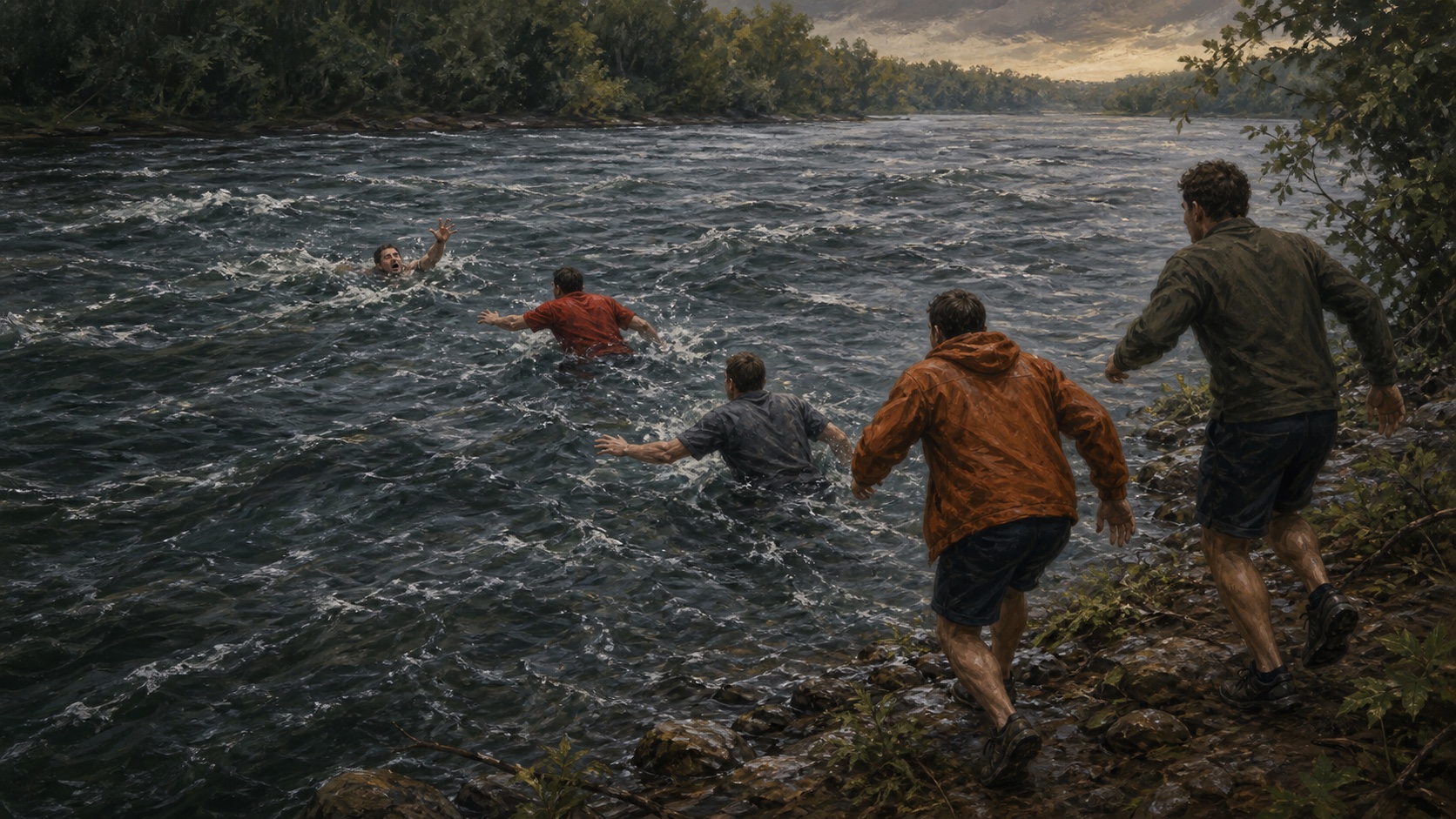
Five deaths in Ohio's Scioto River reveal how action bias, urgency, optimism, and social proof can turn one emergency into a rescue cascade.
On Sunday evening, a group of adults and children gathered beside the Scioto River near Powell, Ohio. One adult entered the water to swim and began struggling. What followed was not one drowning emergency but a rapidly expanding chain of them.
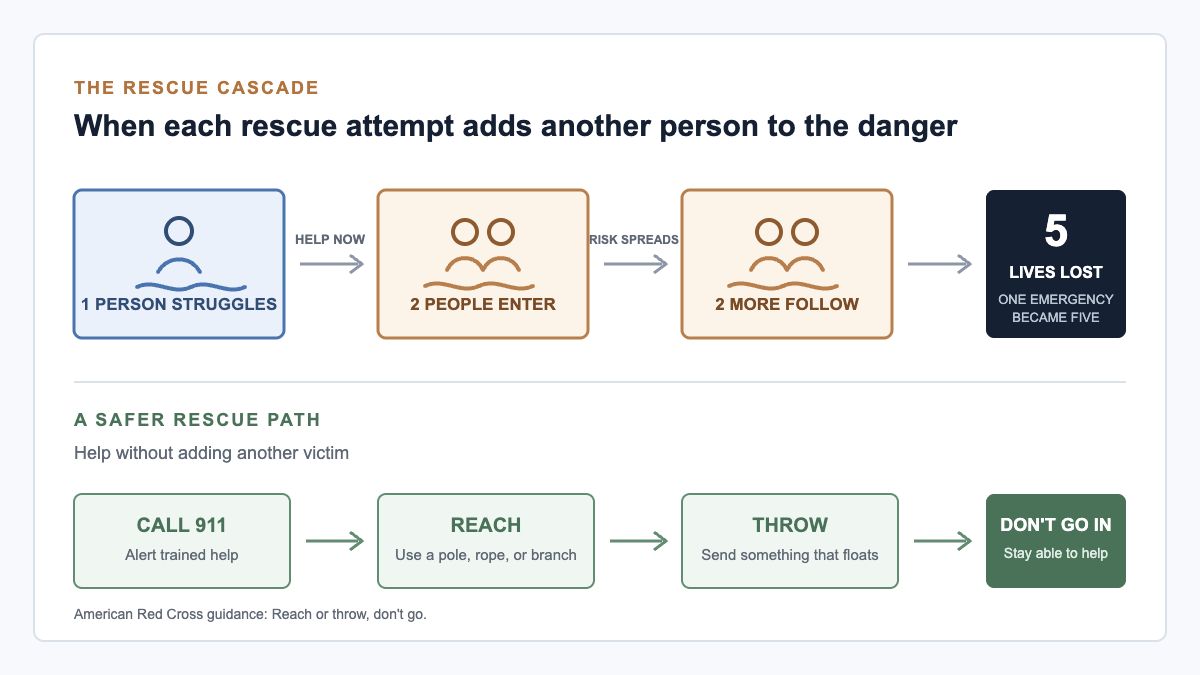
According to officials cited by Reuters, two adults entered the river to help the first swimmer and also got into trouble. Two more adults then went in after them. By Monday, rescue crews had recovered the bodies of two women and three men. Five adults were dead, while two children from the group survived.
The water was not behaving like a calm summer backdrop. U.S. Geological Survey data cited by the Associated Press showed the river flowing at roughly 350 cubic feet per second that Sunday - more than four times its rate three days earlier and more than twice its average. A current can look readable from shore while exerting a force that is difficult to understand until it has already taken control.
What We Know - and What We Do Not
The investigation was still developing when this article was written. Authorities had described the apparent sequence, but they had not published a second-by-second reconstruction. We do not know what each person saw, said, understood, or believed before entering the river. We should not turn incomplete reporting into a confident diagnosis of five individual minds.
But we can examine the decision pattern because it is larger than this one family and this one river. Untrained rescuers becoming victims is a known water-safety danger. The American Red Cross teaches a memorable rule for exactly this reason: 'Reach or throw, don't go.' The rule exists because the impulse to help can be morally admirable and physically disastrous at the same time.
The Trap Was Not Caring Too Much
It is easy to look at the final number and ask how five people could die trying to save one. That question can quickly become contempt disguised as analysis. The more useful question is harder: Why can the most dangerous response feel like the most compassionate one?
The central trap is not love, courage, or loyalty. It is confusing immediate movement with effective help. In an emergency, standing on shore to call 911, find a rope, extend a branch, or throw something buoyant can feel passive. Entering the water feels decisive. One action looks like concern; the other can look like hesitation. The body begins moving before the mind has compared the outcomes.
Action Bias: When Motion Feels Like Help
Action bias is the preference for doing something over doing nothing, even when the available action is ineffective or increases the danger. It is especially powerful when delay feels shameful. A person in front of us is disappearing beneath the water. Every second matters. The pressure is not merely practical; it is moral. What kind of person stays on land?
That framing hides the real choice. The options are not 'jump in' or 'abandon them.' The options include shouting for help, assigning someone to call 911, reaching with a long object, throwing flotation, maintaining visual contact, directing others away from the water, and waiting for trained rescuers. These actions may look less heroic because they do not resemble the rescue scene we expect. They are still actions - and often better ones.
Action bias is relieving because movement discharges helplessness. It gives fear somewhere to go. But an action can reduce the rescuer's emotional discomfort while reducing the victim's chance of survival. The critical question is not whether I am acting. It is whether my action is improving the system or adding another emergency to it.
Urgency Narrows the Menu
Under extreme time pressure, attention narrows. The mind locks onto the most visible object - the person in the water - and the most direct path toward it. Equipment, current, footing, distance, communication, and one's own swimming limitations can fade into the background. This is sometimes called attentional narrowing or tunnel vision. It is not stupidity. It is a normal emergency response that becomes dangerous when the obvious action is the wrong one.
The narrowing also produces a false binary: act now or lose them. Yet effective emergency response often depends on inserting a tiny pause before commitment. That pause is not indifference. It is where a person notices the rope, calls for professional help, tells someone else to bring flotation, or remembers that a panicking swimmer can pull an untrained rescuer underwater.
Optimism Bias: I Can Handle What They Could Not
Optimism bias allows a person to acknowledge a danger in general while discounting the chance that it will overwhelm them personally. I am a stronger swimmer. I will stay calm. I will only be in the water for a moment. I can reach them and come right back. Each thought may be sincere. None changes the current.
The first failed rescue should objectively increase the perceived danger. Emotionally, it can do the opposite: it increases the need to act. Now there are more people to save, including people the next rescuer may love. The stakes rise faster than the plan improves. Confidence is asked to compensate for the absence of training, flotation, and control.
Social Proof: The First Rescue Changes the Next Decision
Social proof is the tendency to use other people's behavior as evidence for what the situation requires. On the Thinking Traps site, the closely related bandwagon effect describes how seeing others choose an action can make following feel more justified. In ordinary life this can shape purchases or opinions. In a crisis it can shape bodies in motion.
Once one person enters the water, entry can become the established rescue method. The next person is no longer inventing a response from scratch; they are joining an effort already underway. If the first rescuers begin struggling, the scene creates an even stronger demand for assistance. Each new victim becomes another reason to repeat the action that produced the new victim.
This is how a rescue cascade can grow without anyone consciously deciding that the water is safe. The group is responding to people, not evaluating a river. The behavior of the others supplies urgency, permission, and a script.
The Hero Script
Popular stories teach a simple visual grammar of courage: someone is in danger, the hero moves toward them, and hesitation belongs to cowards. Water rescues on screen often compress training, equipment, currents, panic, and coordination into a clean leap followed by a grateful embrace. We absorb the image even when we know fiction is fiction.
Real courage is less cinematic. It may look like refusing to become the sixth person in the water. It may mean shouting instructions from shore while someone mistakes your restraint for fear. It may mean choosing the method with the best survival odds instead of the gesture that most clearly displays your intentions.
The Red Cross Rule: Reach or Throw, Don't Go
The American Red Cross recommends helping a person in trouble by reaching or throwing rather than entering the water. A reaching assist can use a pole, branch, paddle, rope, or other object the swimmer can grab. A throwing assist can use a ring buoy, life jacket, cooler, ball, or another object that floats. Ideally, the rescuer stays on stable ground and keeps enough distance to avoid being pulled in.
The first move should also be to alert a lifeguard or shout for help and have someone call 911. Those instructions can feel maddeningly indirect when a life is disappearing in front of you. That is precisely why they must be learned before the emergency. Panic is a poor time to invent a rescue protocol.
'Don't go' is not an absolute command against every water entry by every person. Trained lifeguards and rescue professionals enter dangerous water with practiced techniques, backup, and equipment. The rule is aimed at untrained bystanders whose direct-contact rescue may place both people at greater risk. Swimming ability alone is not rescue training.
A distressed swimmer may climb, grab, and push downward in an involuntary attempt to breathe. Fast current adds another force neither person can negotiate through goodwill. The Red Cross warning is blunt because the physics are blunt: if you enter without a safe method, the emergency may gain a victim without gaining a rescuer.
Compassion Needs a Protocol
There is a broader lesson here beyond water. In fires, violence, medical emergencies, financial panics, and online pile-ons, urgency can make the fastest visible response feel synonymous with helping. Sometimes it is. Sometimes the urge to prove that we care overrides the quieter work of identifying what would actually improve the outcome.
Good intentions matter morally, but they do not repeal cause and effect. A person can be brave and make a fatal decision. A person can hesitate and make the lifesaving one. If we judge only the visible intensity of the response, we reward the performance of concern rather than the competence of care.
The humane response to this tragedy is not ridicule. It is to learn the rule that panic can erase: call, reach, throw, and do not add your body to the danger. Respect for the dead should not require silence about the mechanism that killed them. If speaking plainly helps one future bystander remain useful on shore, the truth is not insensitive. It is preventative.
Courage Is Not the Same as Exposure
Five people did not die because compassion is foolish. They died in a situation where compassion appears to have been expressed through the most dangerous available method. That distinction matters. The goal is not to become less willing to help. It is to become harder to recruit into an expanding emergency.
Before acting, ask one question: Am I choosing the action that feels most immediate, or the action most likely to help without creating another victim? In an emergency, the bravest move may be the one that keeps you capable of helping.
Sources and Context
- ABC News: Five dead after attempted rescue of a struggling swimmer
- Associated Press: Five dead in an Ohio river rescue attempt
- Reuters: Officials describe the apparent sequence of rescue attempts
- American Red Cross: Water safety and 'reach or throw, don't go'
- American Red Cross: Why untrained bystander rescues become dangerous
Check question: Am I choosing the action that feels most immediate, or the action most likely to help without creating another victim?